
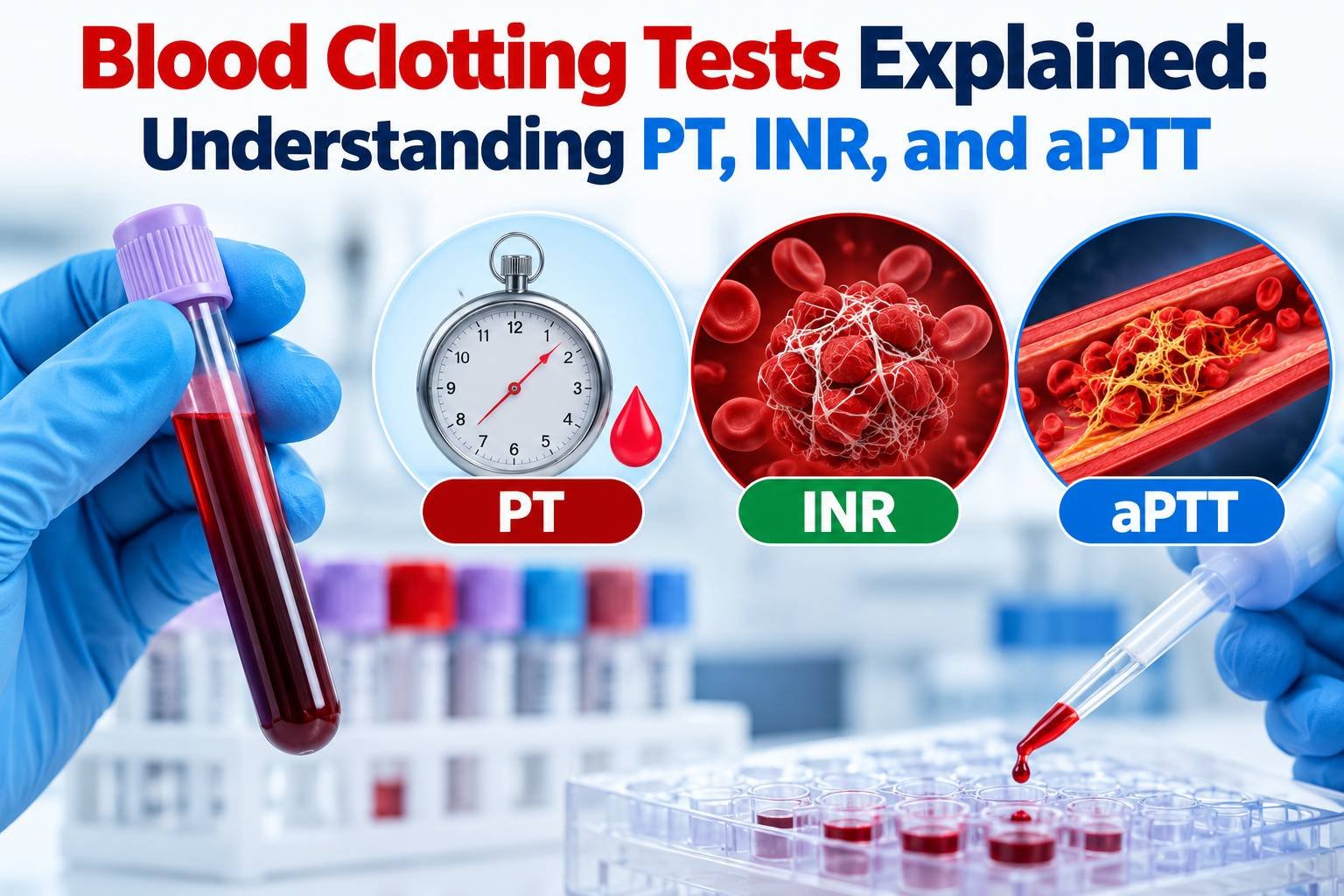
Blood clotting assists your body to prevent bleeding following an injury. Nevertheless, clotting either too slowly or too fast may be a sign of a health issue. Certain blood tests are conducted by doctors to assess the quality of your blood clots and detect potential clotting disorders.
There are three tests that are commonly used: Prothrombin Time (PT), International Normalized Ratio (INR), and Activated Partial Thromboplastin Time (aPTT). Knowing these tests will enable you to make sense of your reports and talk to your doctor about the right course of action.
Blood clotting tests are tests that measure the time your blood takes to form a clot in the laboratory. They assist physicians in evaluating clotting proteins, examining abnormal bleeding, and tracking some blood-thinning drugs.
These tests can be ordered by doctors prior to surgery, following unexplained bleeding or bruising, or in cases of suspected liver disease and clotting disorders. They may also form part of a broader health evaluation, such as a full body checkup delhi ncr, when symptoms or medical history indicate the need for further investigation.
Not all bleeding or clotting disorders are diagnosed by these tests. Physicians analyze findings in combination with symptoms, medications, medical history, and other laboratory results.
Prothrombin Time measures how long plasma takes to clot after specific substances are added to a blood sample. It mainly assesses the extrinsic and common pathways of the clotting process.
Physicians can request a PT test when they are investigating unexplainable bleeding, liver function, or vitamin K deficiency. It may also be used to monitor patients on warfarin, an anticoagulant that decreases the blood clotting ability.
Prolonged PT outcome can be caused by some medications, liver issues, vitamin K deficiency, or clotting factor abnormalities. Nevertheless, one abnormal outcome cannot be used to diagnose a particular condition. To determine the cause, your doctor might prescribe further tests.
The International Normalized Ratio standardizes PT results so laboratories can compare findings more consistently. It is especially significant when individuals are on warfarin, and their treatment should be closely monitored.
An increase in INR tends to indicate slower clot formation and a decrease in INR tends to indicate faster clot formation compared to the standardized reference of the test. However, the appropriate INR range depends on the patient’s medical condition and treatment goals.
INR results are used by doctors to increase or decrease warfarin doses and minimize the risk of bleeding or undesirable clot formation. Patients must never alter their dosage of medication without medical advice.
People arranging a full body checkup in delhi ncr should tell their healthcare provider about anticoagulants and other medicines. The information assists the doctor in making decisions about the suitable tests and interpreting results in a safe manner.
The aPTT test is used to determine the duration of time it takes the plasma to clot following the activation of certain clotting pathways by laboratory reagents. It measures the intrinsic and common pathways and assists in the evaluation of a number of clotting factors.
Physicians can order an aPTT test when they are examining unexplained bleeding, suspected deficiencies of coagulation factors, or some conditions that affect coagulation. It can also monitor unfractionated heparin treatment in appropriate clinical settings.
An extended aPTT can be a sign of clotting factor deficiencies, the existence of some antibodies, or drug influences. Not all individuals who have long-term outcomes can have excessive bleeding, and physicians take into account the entire clinical picture to draw conclusions.
Even though these tests measure blood clotting, they measure various components of the process.
Depending on the symptoms and medical history, doctors can order a single test or a combination of multiple tests. As an illustration, a patient with unexplained bleeding might need PT, INR, aPTT, platelet counts, and other tests.
A full body checkup delhi appointment may help identify broader health concerns, but these clotting tests are not automatically included in every screening package. Check with your healthcare provider to confirm the tests available.
The majority of PT, INR, and aPTT tests demand a vein blood sample. It is usually easy to prepare, but your doctor might have certain requirements depending on your situation.
Remember the following before testing:
If you are considering a full body checkup in delhi, discuss your symptoms and medical history with the provider to determine whether clotting tests are necessary.
PT, INR, and aPTT are useful in giving insights into various stages of the blood clotting process. Doctors use them to investigate bleeding problems, assess certain medical conditions, and monitor specific anticoagulant treatments. Always seek the advice of your doctor to get the right interpretation and follow-up.